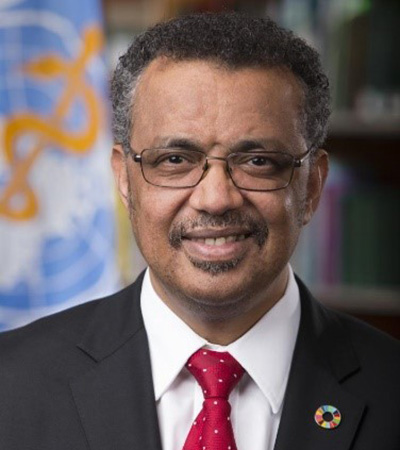
Dr. Tedros Adhanom Ghebreyesus was elected WHO Director-General for a five-year term by WHO Member States at the 20th World Health Assembly. He was the first director-general elected by the World Health Assembly from among multiple candidates.
Picture Credit: Dr. Tedros Adhanom Ghebreyesus
He was born in the Eritrean city of Asmara and graduated from the University of Asmara with a Bachelor of Biology, a Master of Science (MSc) in Immunology of Infectious Diseases from the University of London, a Doctorate of Philosophy (PhD) in Community Health from the University of Nottingham, and an Honorary Fellowship from the London School of Hygiene and Tropical Medicine.
After taking office as WHO Director-General on July 1, 2017, Dr. Tedros initiated a significant transformation in the Organization’s history, achieving a wide range of milestones.new operating model, aligning the Organization’s new structures and ways of working, and across the three levels of the Organization (Headquarters, Regional Offices, and Country Offices). To support the new operating model, several new divisions were established, including the Division of Science, the Division of Data and Delivery for Impact, and the Division of Emergency Preparedness.
Rwanda’s success shows that scalability in global health lies in principles, not templates. What can be replicated globally are strong political leadership, community trust, primary healthcare integration, and data-driven action. What must remain local is the design—shaped by each country’s culture, health system, and social context.
As Rwanda moves toward elimination ahead of schedule, its ethical responsibility is one of solidarity, not instruction. Early success should translate into sharing evidence and experience through respectful, non-paternalistic partnerships, especially via South-South cooperation.
Rwanda’s model also challenges how the world sets global health targets. It demonstrates that progress can be accelerated when countries lead with evidence, rather than follow aspirational timelines set by institutions. This shifts global health from deadline-driven ambition to country-led, science-based action—supported by WHO as a partner in equity.
On scalability, context, and ethical responsibility
Rwanda’s achievement demonstrates that scalability in global health does not mean uniformity. What is universally replicable is not the exact design of the programme, but the principles that underpin it: strong political commitment at the highest level, community trust, integration of prevention and care into primary health systems, data-driven decision-making, and sustained investment in health equity—particularly for women and girls.
Elements such as nationwide HPV vaccination, task-shifting to trained community health workers, school-based delivery platforms, and linkage of screening to treatment are adaptable across settings. However, the how must remain locally designed. Rwanda’s success is rooted in its social cohesion, governance structures, and community engagement mechanisms. These contextual factors cannot be copied; they must be interpreted and re-imagined within each country’s cultural, economic, and health-system realities.