Meet Roshni Shukla, the creative force behind Sugar & Flower Cakes, Bangalore. Renowned for her bespoke buttercream floral cakes and cupcakes, Roshni has spent over a decade transforming simple desserts into stunning edible art. Her dedication and talent have earned her numerous accolades, including Buttercream Cake Artist of the Year 2025 at the Indian Cake Awards, and recognition as one of the Top 25 Homebakers in India and Bangalore.
Beyond her award-winning creations, Roshni is passionate about teaching and mentoring aspiring cake artists. Through her classes, she shares the techniques, secrets, and artistry she has perfected over years of training in India and abroad, inspiring a new generation of bakers to bring their sweet visions to life.
When did you started your journey as well chef?
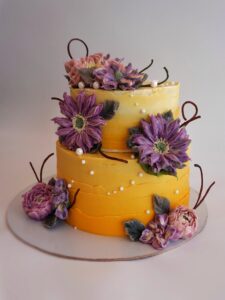
My journey as a professional homebaker began in 2015, when I took my first order after a successful bake sale. Around the same time, I started conducting basic baking classes. As my orders increased, I focused on creating cakes for various occasions, experimenting with fondant cakes, themed designs, and floral styles.In 2020, after winning my first cake competition, I decided to fully specialize in floral cakes. That moment marked a turning point in my journey—there was no looking back. I realized that creating buttercream florals brought me the greatest joy, and it continues to inspire my work every day.
Buttercream florals have become your signature style. What drew you to buttercream as a medium, and how do you see it evolving as an art form compared to fondant or other techniques?
When I first started baking and decorating cakes, I experimented with many different mediums. Over time, especially after attending a healthy baking seminar organised by the Ovenderful Community, I became more conscious of what goes into the cakes we make and consume. While themed cakes will always involve some indulgence, I wanted to minimise ingredients that are purely decorative but not enjoyable to eat.

Buttercream naturally stood out. It tastes great, is relatively approachable as a medium, and offers a surprising amount of versatility. It also has a long history—being one of the oldest forms of frosting, with many variations across different cultures and regions. I was particularly drawn to how buttercream allows for soft, expressive work, which eventually led me towards floral designs as a way to explore texture, movement, and detail.
Fondant and other decorative mediums might continue to dominate the spotlight, largely because of their stability and sculptural possibilities. However, I feel buttercream is gradually reclaiming it’s place. Especially as people increasingly value cakes that are meant to be fully enjoyed; rather than peeling off fondant or discarding decorative toppers. While buttercream may not offer the same structural flexibility as some other techniques, it’s potential for artistry is vast. With the right skill and intention, it allows for expressive, detailed work that is both beautiful and genuinely enjoyable to eat.
Having trained both in India and abroad, how have global perspectives influenced your approach to cake artistry, and what uniquely Indian elements do you consciously bring into your work?
Training both in India and abroad has given me a broader perspective on cake artistry, not just in terms of technique but also in how learning environments are structured. When I attended classes abroad, I found them to be extremely well organised and thoughtfully structured, with a strong emphasis on process, consistency, and understanding the “why” behind each technique. That experience influenced how I approach my own work and teaching today, especially in terms of planning, discipline, and building skills step by step.
At the same time, the cake industry in India has grown tremendously over the years. While opportunities and access were more limited earlier on, today we have world-class cake artists and excellent institutions offering high-quality training right here. Indian decorators are no longer just keeping pace globally—we are contributing to the conversation with our own voices and styles.
What I consciously bring into my work are elements rooted in Indian sensibilities: a love for colour, intricate detailing, and inspiration drawn from nature, textiles, festivals and traditional floral forms. These influences naturally translate into my buttercream florals and overall aesthetic, allowing me to blend global techniques with an unmistakably Indian warmth and richness.
You’ve transitioned from being a homebaker to an award-winning cake artist and educator. What were the most critical mindset or skill shifts required to make that leap successfully?
The most critical shift for me was making a conscious decision to choose and fully commit to a niche. When I first began offering floral cakes, it was simply an additional option on my menu. Winning my first cake competition in 2020, however, completely changed my perspective. It pushed me to make a clear decision to focus entirely on buttercream florals.
That commitment meant letting go of everything else. I went back to my Instagram page and removed all fondant and themed cakes because I wanted clarity—if someone in Bangalore thought of a buttercream floral cake, I wanted my name to be the first that came to mind. This shift from being a generalist to a specialist was as much a mindset change as it was a business decision.
Over time, that goal naturally expanded. I didn’t just want to be known locally—I wanted to push myself to reach a level of excellence that could stand alongside the best in the country. That meant holding myself to higher standards every single day and constantly refining my work.
Skill-wise, it required relentless practice and self-directed learning. Since there were very few people pursuing this style at the time, I had to seek out resources independently. I studied countless videos—often watching the same one dozens of times just to understand a subtle hand movement or flick of the wrist, especially when the content was in foreign languages. I followed floral cake artists from around the world, reached out to them to learn about tools and techniques, and invested deeply in understanding the medium.
A turning point was receiving my first set of Korean piping tips in 2017, gifted by my father. The improvement in my work was immediate, and I still use many of those tips today. Over time, I also learned how to adapt and tune locally made piping tips to achieve similar results. One of the most meaningful full-circle moments for me was being approached by that same company this year, to promote their new line of piping tips on my social media page.
I don’t believe this journey was driven by natural talent alone. More than anything, it was built on consistency, patience, and practice. While there may be many talented artists, I truly believe the time and effort I’ve invested in refining this one skill has been what allowed me to make that transition successfully.
As an instructor, how do you balance technical precision with creative freedom when mentoring students who want to develop their own artistic voice rather than replicate styles?
My classes are structured in stages.. We always begin with fundamentals—colour theory, how to hold the piping bag, piping techniques, pressure control, angles etc. This technical foundation gives students the confidence and control they need to pipe flowers on their own.
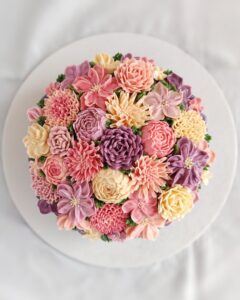
Once those basics are in place, I encourage students to see their cakes or cupcakes as their own canvases. At that stage, they decorate freely and make their own creative decisions. I remain present as a guide, offering technical support and gentle suggestions when needed, but largely stepping back so they can explore their own ideas.
This approach allows students to apply technique without feeling constrained by imitation. Watching their designs come to life—and seeing their confidence grow—is the most rewarding part of teaching. I never get tired of seeing their excitement when they finish or hearing them say, “I can’t believe I made that!” Those are the moments when they start to realise their own creative potential.
With over a decade in the industry and numerous accolades, what do you believe truly defines excellence in cake artistry today—is it technique, originality, storytelling, or something deeper?
For me, true excellence lies in the harmony of skill, intention, authenticity, and continuous refinement. I think it is a combination of all of the above, along with consistency. Technique is essential—it provides precision, structure, and credibility.Originality gives the artist a distinct voice, while storytelling creates emotional connection and meaning.
Working with buttercream florals has taught me that true mastery comes from consistency and long-term commitment to the craft. It is built through repetition, discipline, and respect for the medium. Showing up for your craft over and over again, in spite of failures or successes, is essential.
Equally important is evolution—the willingness to learn, adapt, and grow with time while staying true to one’s artistic values. Ultimately, excellence lies in the harmony of skill, intention, authenticity, and continuous refinement.
Winning the Indian Cake Award for Buttercream Cake Artist of the Year 2025 is a significant milestone—beyond personal recognition, what do you believe this award represents for the evolution of buttercream artistry in India, and how do you see your role in shaping its future?
The very inclusion of a dedicated buttercream category in several cake awards recently, is a powerful indicator of how far this medium has evolved. For a long time, buttercream was largely associated with simpler designs and smaller celebrations, rather than being viewed as a medium for high-end or expressive cake artistry. However, there is an exiting shift happening.
The range of work being created—by many artists across our country and the world—highlights the vast potential of buttercream, from painting techniques and palette-knife textures, to refined wedding cakes and sculptural forms. In many ways, we are only beginning to explore what this medium is capable of.
Beyond personal recognition, this award represents a collective moment for buttercream artistry. I hope that, through our work, we continue to showcase its versatility and beauty, inspire more artists to embrace it, and encourage pushing artistic boundaries. My role, as I see it, is to contribute to this evolution—by refining the craft, sharing knowledge, and helping shape a future where buttercream is recognised as a serious and powerful artistic medium.