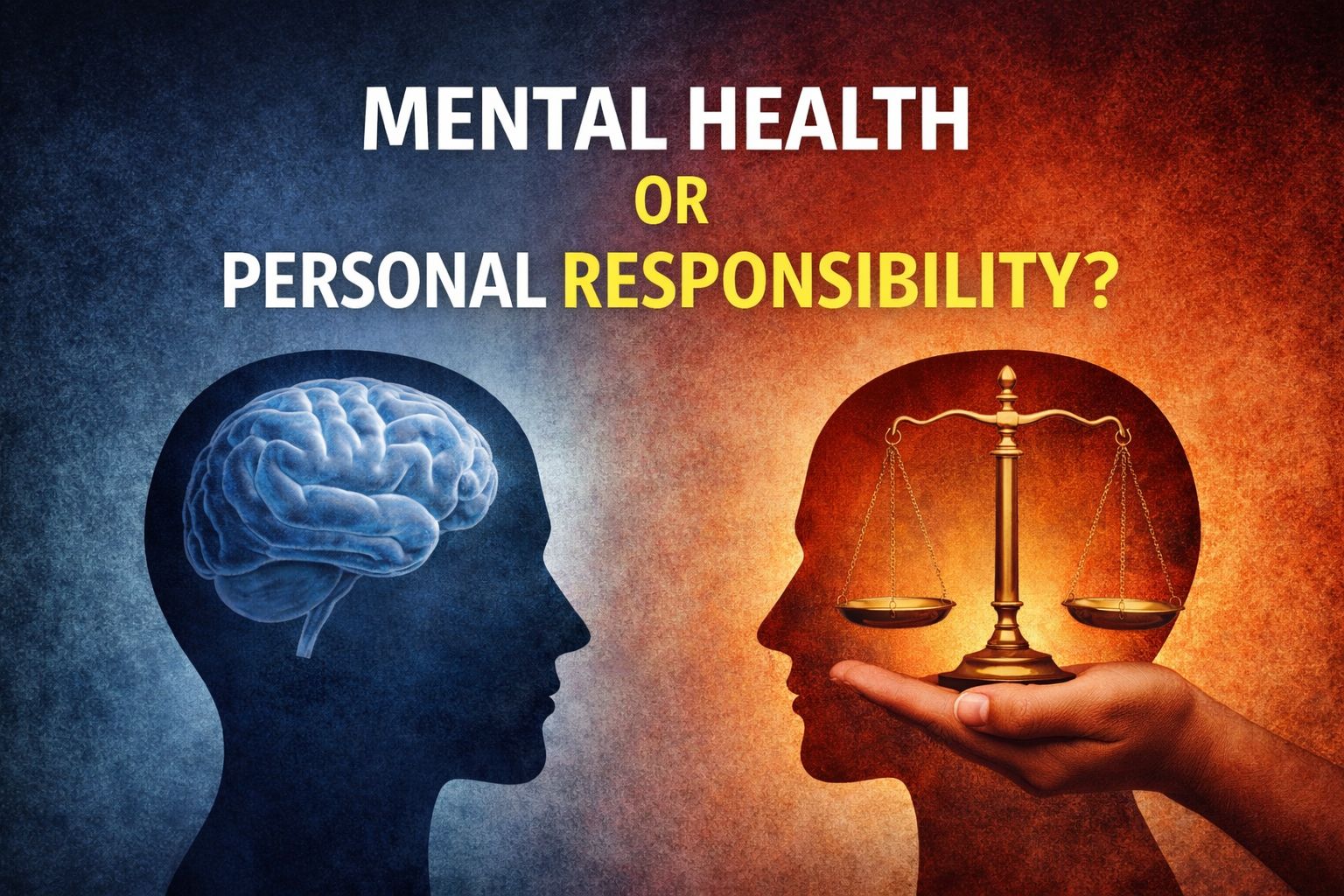
The conversation around mental health has finally become mainstream and that’s a victory hard-won. We talk more openly about anxiety depression trauma and burnout. We know how to identify with the signs and symptoms that show up and not suppress their existence. We name what earlier generations swallowed silently. But as the language of mental health becomes more familiar, a difficult question quietly emerges beneath the surface :
Where does mental health support end and where does personal responsibility begin?
This question is often loaded with judgement on one side and defensiveness on the other. Some argue that mental health has become an excuse a soft cushion against accountability. Others feel deeply invalidated by this narrative and framing as though their pain is being dismissed as weakness or laziness.
As a therapist I sit in the middle of this tension. And the truth is unsurprisingly way more complex than either extreme.
Mental Health is not a choice. Responsibility Is. No one chooses panic attacks, intrusive thoughts , emotional overwhelm or numbness or trauma responses. The nervous system does not ask for consent before it adapts to stress , neglect or danger.
Much of what we call “Mental Health Struggles” are not character flaws they are adaptive survival responses.
I have worked with high functioning professionals who feel ashamed because on paper their lives look perfect. Yet their bodies are stuck in chronic fight-flight-freeze-fawn. I have seen students paralysed with anxiety who desperately want to work, study and show up but can’t access their capacity without support.
In these moments mental health is not about willpower. It is about biology psychology and lived experience.
But here’s the part we often avoid saying out loud.
While you are not responsible for having a mental health condition, you are gradually responsible for how you respond to it.
Tha responsibility is not immediate. It’s not harsh. And it’s certainly isn’t linear. But it does exist.
But validation alone is not healing
Here is where the conversation must mature acknowledging trauma, stress, and systematic pressure is essential, but it is not sufficient for recovery.
Mental healthcare is not meant to replace personal agency. It is meant to restore it.
In clinical practice, one of the most disabling patterns, I see is what psychology calls learned helplessness: when individuals after prolonged invalidation or control lose faith in their own capacity to influence outcomes. In India, this is often reinforced by families who oscillate between over protection and criticism.
When mental health language is absorbed without psychological depth, it can unintentionally reinforce passivity:
● “ this is just how I am”
● “ I can’t function because of my anxiety”
● “ my trauma means I can’t be expected to try”
These statements are understandable. But they are also incomplete.
Mental health explains behaviour. It does not excuse the abandonment of responsibility, indefinitely.
Responsibility is not the same as self blame.
This is very Indian discourse, collapses nuance.
Responsibility is often confused with harshness. But psychologically is pone. Asi Beel is not about forcing productivity or suppressing pain. It is about participation in one’s own recovery.
Responsibility looks like
● Seeking help instead of normalising suffering
● Staying in Therapy, even when discomfort arises
● Practising regulation tools, despite low motivation
● Taking accountability for emotional spillover in relationship
● Accepting that Healing requires sustained effort time and not Insight alone
This form of responsibility is developmentally healthy. It’s strength, self efficacy. The belief that I can act even imperfectly.
Without this belief, no amount of validation leads to change
The Indian family factor
Any discussion of responsibility in India must address the family system. Indian families, often discourage boundaries, reward, sacrifice, shame, individual, and expect emotional resilience without emotional literacy.
As a result, many individuals reach adulthood, having never been taught emotional responsibility only obedience.
Therapy then becomes the first space where they are asked to reflect choose an act for themselves. This can feel this destabilising even frightening. Resistance is not laziness. It is unfamiliarity with agency.
Mental health work in India, therefore, must do two things simultaneously:
1. Deconstruct, internalised, guilt, and shame
2. Gradually introduced responsibility as empowerment not punishment.
A shared effort, not a solo burden
Mental health is not an individual project in isolation.
Social systems, family dynamics, Work cultures, and economic realities, all shape, psychological well-being. Responsibility should never become an excuse to ignore these structures.
But neither should awareness become a reason to opt out of Growth.
Healing is relational. It asks for support and participation.
The middle Path
So is mental health primarily about personal responsibility?
No
And also, eventually, yes
It begins with compassion, validation, and support.
It continues with Insight and skill building.
And overtime. It gently invites responsibility, not as punishment, but as possibility.
Because responsibility, when held with kindness is not a burden.
It is how people reclaim authorship over their own lives.
Khushi Kumar is a Psychotherapist and sex therapist working with young adults and professionals. Her work focuses on trauma, informed, relational, and integrative approaches to psychological and emotional healing.