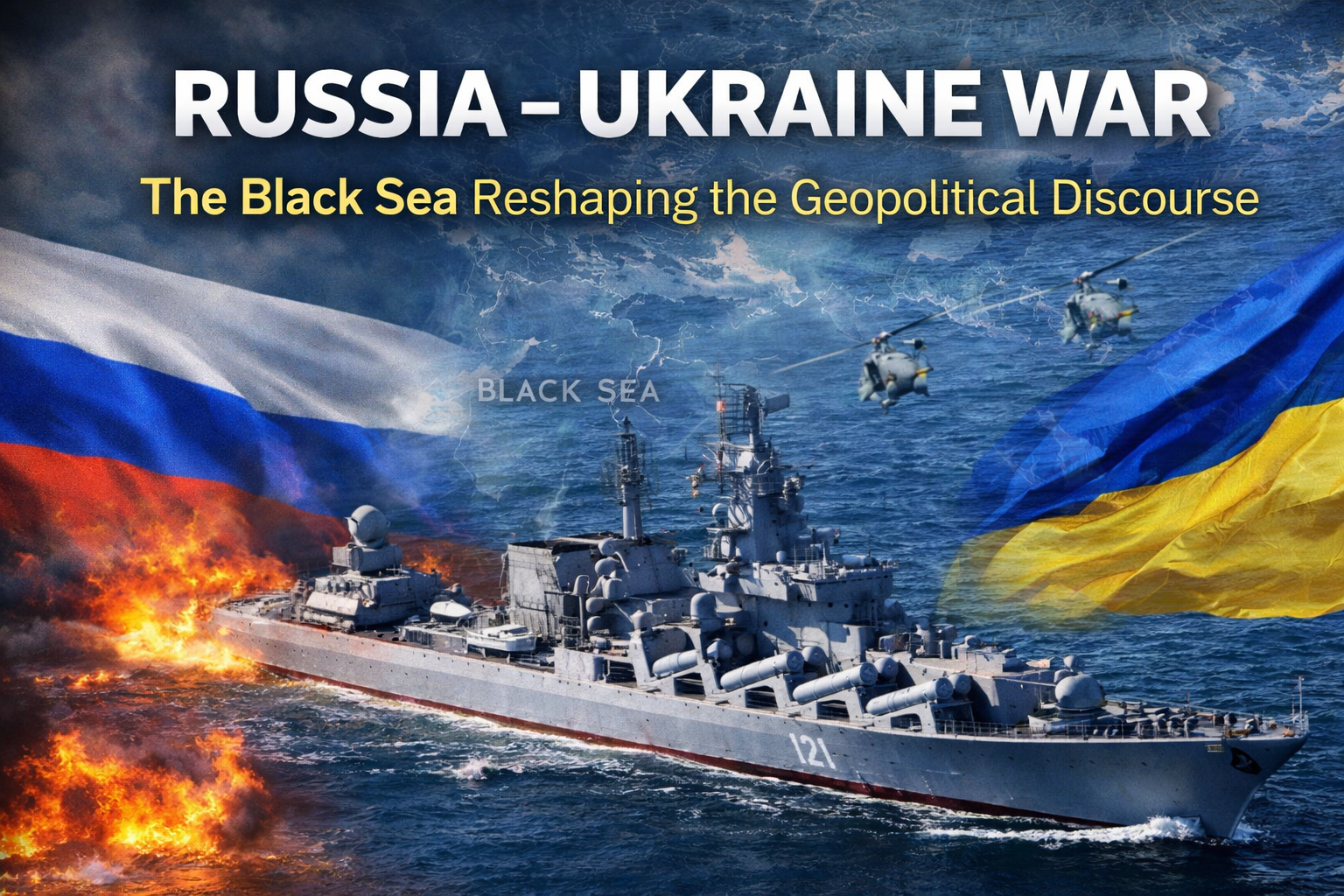
RUSSIA UKRAINE WAR: On 24th February 2025, Russia launched a full scale invasion of Ukraine escalating a conflict which predominantly started in 2014. The conflict has been a clear violation of UN Charter’s prohibition on the use of force. Russia has justified its actions on the pretext of rapid expansion of NATO along its borders.
The western countries have provided logistic and military aid however have avoided any direct confrontation with the Russian forces. Economic sanctions have been a major tool of the west in order to curb the Russian activities. Ukranian refugees have been largely absorbed by Poland leading to some relief for the refugees.
Russian Federation have claimed with the increase in the number of membership of eastern European countries into NATO and the growing cooperation between Ukraine and NATO, the Russian Federation sees it as a security threat to its sovereignty since it would allow for direct confrontation with the Russian borders and hence it is how they have defended their activities for the same. The Russian Federation has also shown deep interest in protecting the Russian-speaking people in eastern Ukraine, particularly in the Donetsk and Luhansk regions from discrimination and repression at the hands of the Ukranian Authority.
Ukraine has argued that the invasion is a direct assault on its sovereignty and a violation of established international borders. Under Article 2(4) of the United Nations Charter, states are prohibited from using force against the territorial integrity or political independence of another state and Ukraine have expressed the same at the international forum on repeated events. The UN General Assembly passed resolutions condemning the invasion and have demanded Russian withdrawal however having no legal binding and hence it has had no effect on the war activities as such.
Ukranian resistance has been strengthened by the national upliftment of unity and strong leadership. Ukraine’s leadership framed the war as a fight for survival and dignity, which strengthened the spirit of the belongingness among the citizens and is seen as a obstacle in the Russian advancement into Ukraine.
President Volodymyr Zelenskyy has addressed both his citizens as well as presented itself in the international forum as a victim of war. Prior to the invasion Ukraine has received years of military training from NATO member states which has further agitated the Russian Federation.
Following the invasion of Ukraine Western countries have avoided direct confrontation but have started using sanctions as a medium to cripple the Russian economy. The objective was not immediate military defeat, but long-term economic, financial, and technological isolation which have long terms effects on its foreign policy, economy and future activities as a country.
The coordination of sanctions on affecting various aspects of the Russian economy has made it significantly different from the sanctions which where imposed on Russia in 2014 for its actions in Crimea. Russian oil and gas exports which make up a large part of its exports and revenue stream have been restricted thereby making the Russian federation to look for alternative buyers. Russia continued to earn from this revenue stream by exporting to countries such as India and China.
The sanctions however have had much effect in its economy since it has lead to reduced foreign investment in the economy, withdrawal of various multinational companies leading to shortage of goods and services in the market and restriction in access to technologies related to semiconductors and aerospace components which are viral parts in running an economy.
Major Russian banks were excluded from the global SWIFT financial messaging system, restricting their ability to conduct international transactions. Russia’s central bank assets held abroad were frozen which had led to unrest in the Russian population and had greatly affected the Russian economy’s foreign exchange reserves.
The RUSSIA UKRAINE WAR triggered one of the largest humanitarian crises in Europe since World War II. Large scale bombing and infrastructure destruction which has deeply affected the daily lives of the Ukranian citizen and led to influx of refugees into neighbouring countries such as Poland, Romania, Hungary, Slovakia, and Moldova hence leading to straining of their economies in the long run. Certain refugees have also started seeking asylum in these countries to ensure a protected future for them and their families.
The Russia Ukraine has put a spark on the age old cold war between the east and west. It has highlighted the change in geopolitical divisions thereby reshaping global politics around opposing power blocs. However direct military confrontation which was negligible in the preexisting cold war has risen and shown its colours in recent times in the form of economic sanctions, diplomatic isolation and information an cyber warfare. There has been a increase in the number of countries presenting themselves as neutral showing non aligned positions against the actions of other countries. This war has again sparked the age old arms race between countries leading to cold war all over again.
Since the start of the war, global food security has been threatened and at stages has come to a standstill since Ukraine is one of the world’s major exporters of wheat, maize, barley, and sunflower oil and the war has disrupted its exports. The sea routes pertaining to the black sea have been heavily blocked leading to logistic and global supply constraints. The Black Sea Grain Arrangement has temporarily provided relief however it is been strained to its limits.
This has resulted in rising inflation in various economies of the world and has resulted in fiscal stress since it became necessary to subsidize food items in order for them to be within the means of the public. Higher import bills have severely affected the foreign exchange reserves of countries and thereby hurting the purchasing capacity of the low and middle income families.
Russia and Belarus are major exporters of fertilizers however after the invasion, their roles have diminished leading to constrain supply in the global market. Agencies like the Food and Agriculture Organization warned of increased acute food insecurity due to reduced affordability rather than absolute shortages.
The Russia Ukraine war has fundamentally changed its narrative on solving disputes sorely based on dialogue and diplomacy. Now the European Union has heavily fired up its defense capabilities incase of any escalations from the war. Several European counties have announced an increase in their defense expenditure meeting or exceeding 2% of their GDP. Germany has announced a rearmament programme, a first post the second world war.
This shows the European countries preparing for a harsh future if it may so to occur in the future. Non aligned counties which had a neutral policy such as Finland and Sweden have faced a shift from this policy after the Russian war due to its proximity to the Russian border.
The is often described as the first large information war of the digital era. Russia as well as Ukraine have used their state controlled media to put forth their ideas, perspectives and narratives infront of the world to gain support and confidence. Both sides have engaged in psychological warfare for gaining acceptance from the outside world for aid as well as support.
Information warfare has extended into cyberattacks into both the countries official government websites as well as government infrastructure hence trying to put down the enemy’s forward line of defense. The aim of such attacks is to disrupt the functioning of the opposing nation thereby causing governing problems for the governments. President Zelenskyy’s personalized videos on social media platform has Ukraine’s narrative accessible worldwide.
Ordinary civilians and soldiers trapped between the line of fire have expressed their thoughts, wishes and actions on the internet and gaining attention through the same as well. The main motive of using such global social media platforms is to influence the governments involved to adopt dialogue and diplomatic interventions rather than direct military warfare and increase parts of humanitarian aid for victims of war.
Social media algorithms prioritize emotionally charged content, which amplified graphic images and extreme narratives. This intensified polarization, simplified complex realities, and sometimes reduced nuanced debate to moral binaries. Russia relied heavily on traditional, high-intensity warfare tactics, reflecting both its military doctrine and battlefield constraints and its military power to the world as a global superpower. Russia has used long range missiles and heavy artillery to barriage on the Ukranian infrastructure and instill fear among its population.
Russia relied on more artillery and volume based missile attacks rather than territorial advancement of its army also involving extensive urban destruction and civilian losses. Multiple peace talks have taken place between the two countries however they have failed on multiple instances leading to advancement into the war and deteriotion of the civilians lives.
The failure was due to Ukraine’s refusal of giving any territory to the Russian federation and the Russian Federation insisting for territorial claims of the land. Very little room is kept for compromise hence leading to deadlock in political meeting between the two countries.
Russia having the upper hand in the United Nations Security Council due to its veto power hasn’t allowed for any condemning or restraining actions opposed on him. The inability of international institutions to prevent or halt the conflict weakened global faith in multilateralism. Smaller states, in particular, questioned whether international guarantees genuinely ensure security.
Another important aspect of this war, is the position The Republic Of China has depicted itself on the global stage regarding the conflict. The Republic of China has called for ceasefire, and respect for territorial integrity, while avoiding direct condemnation of Russia. This proves that the Republic of China is picturing as a mediator as well as advisor for both the countries.
However The Republic of China has globally critized the unlawful economic sanctions which have been put on Russia since such activities would largely affect the global economy and lead to instability within other countries. Russia repeatedly referenced its nuclear capabilities during the conflict, using nuclear rhetoric as a deterrent against direct Western military intervention. T
his reintroduced nuclear threats into mainstream geopolitical discourse, something largely absent in Europe since the Cold War. Trust has been largely absent between the nuclear powered countries leading to stability and insecurity in the economies of the world. The combination of high-intensity conventional war, nuclear signalling, and weakened communication channels increased the risk of miscalculation or accidental escalation. Security analysts warn that prolonged conflict without robust arms control mechanisms heightens global nuclear instability.
Now Ukraine is facing sevear challenges for its reconstruction due to its crumbling economy. Large parts of Ukraine have crumbled leaving only rebbles for the civilians. Many have lost their means of livelihood, shelters and close ones due the war. Entire cities and towns were left partially or completely uninhabitable, requiring rebuilding rather than simple repair.
The war has greatly affected the industrial and agriculture output that is the backbone of an economy which are essential for its revival. Reconstruction costs are gonna exceed billions of dollars thereby exceeding the capacity of the domestic economy to sustain itself or rebuild itself for such a heavy shock. The war thus marks a defining moment in shaping how power, security, and international cooperation will function in the 21st century.
RUSSIA UKRAINE WAR: Natalie Sabanadze Statement On black sea important to Moscow
For the best part of two decades, Europe and NATO have underestimated Russia and its motivation to dominate the Black Sea region. Understanding the patterns of consistency and adaptation in Moscow’s Black Sea posture is essential for anticipating the country’s future strategic behaviour. Russia’s continued use of hybrid and full-scale warfare in the Black Sea, if successful, would have devastating repercussions for the wider region.
Central to Black Sea security is ensuring that Ukraine retains control of Odesa and its adjacent coastline. Any ceasefire or future peace agreement must include provisions for long-term deterrence against renewed Russian efforts to sever Ukraine’s access to the Black Sea. Such a move would not only undermine Ukraine’s economic viability but also diminish its broader strategic relevance.
Ankara’s adherence to the Montreux Convention, which prevents military vessels from entering the Black Sea region during wartime, has had a significant impact on Russia’s ambitions. Consequently, Turkey will continue to be a pivotal actor in the Black Sea and a vital partner for the West, due to the country’s control of the Turkish Straits, its possession of the longest coastline in the region and its significant geopolitical weight.